


Around the Globe: Europe
European Federation of Pharmaceutical Industries and Associations (EFPIA)
Association of the British Pharmaceutical Industry (ABPI)
EFPIA; Vaccines Europe, Belgium
reventive medicines can spare people from serious illness, reduce pressure on health systems, and are often highly cost-effective in the long term. The problem is that our clinical and care systems are built for treating patients when they become sick rather than avoiding ill health in the first place.
Key points
- Prevention is a powerful tool in public health with potential to improve lives and support health service sustainability;
- Preventive health goes beyond lifestyle change to include immunization and medicines that reduce the risk of illness;
- Established systems are designed for therapeutic interventions and may be suboptimal for prevention strategies;
- New regulatory and access approaches are needed.
Beyond Lifestyle Changes
The fundamental concept of avoiding ill health rather than trying to fix problems when they arise is one most people can embrace. The old adage “An ounce of prevention is worth a pound of cure” is inherently appealing. As prevention is not only better for individuals, but often more efficient and cheaper for both individuals and society, it has become an imperative in the era of aging populations and rising demands on health services.
However, our view of prevention tends to be reduced to a set of lifestyle interventions. This puts the burden on people to manage their own behavioral risk factors: Eat well, exercise, quit smoking. While this remains sound advice, it reflects a mindset that separates prevention from medicine and the growing innovation in the field. This line of thinking sees preventive measures as a matter for individuals and limits our view of “medical interventions” to the treatments that are developed, regulated, and administered by the wider medical system.
Modern medical science, of course, is more complicated than that. It is also more interesting, more dynamic, and more exciting. Advances in our understanding of why things sometimes go wrong in the cells and systems that make up our bodies have, for decades, been changing how we think about health. While the power to predict illness is imperfect, we are better placed than ever before to identify markers of disease years—even decades—before symptoms emerge.
Several preventive medicinal products have overcome regulatory and access barriers to reduce episodes of ill health and save lives. Statins are widely used to prevent heart attacks and strokes by reducing cholesterol, a major risk factor for cardiovascular disease. Vaccines against human papillomavirus (HPV) are driving down infections that cause precancerous lesions, ultimately preventing cervical cancer. The potential of GLP-1 agonists to prevent obesity-related illness is an area of enormous interest to researchers, payers, and patients alike.
These products illustrate the need to think about surrogate endpoints given, for example, the time lag between a HPV vaccine administered in adolescence and the nonoccurrence of cancer decades later. They also show the power of prevention in protecting population health. However, there is scope to achieve much more by reimagining incentives and pathways for preventive interventions.

How to “Prove” That Prevention Works
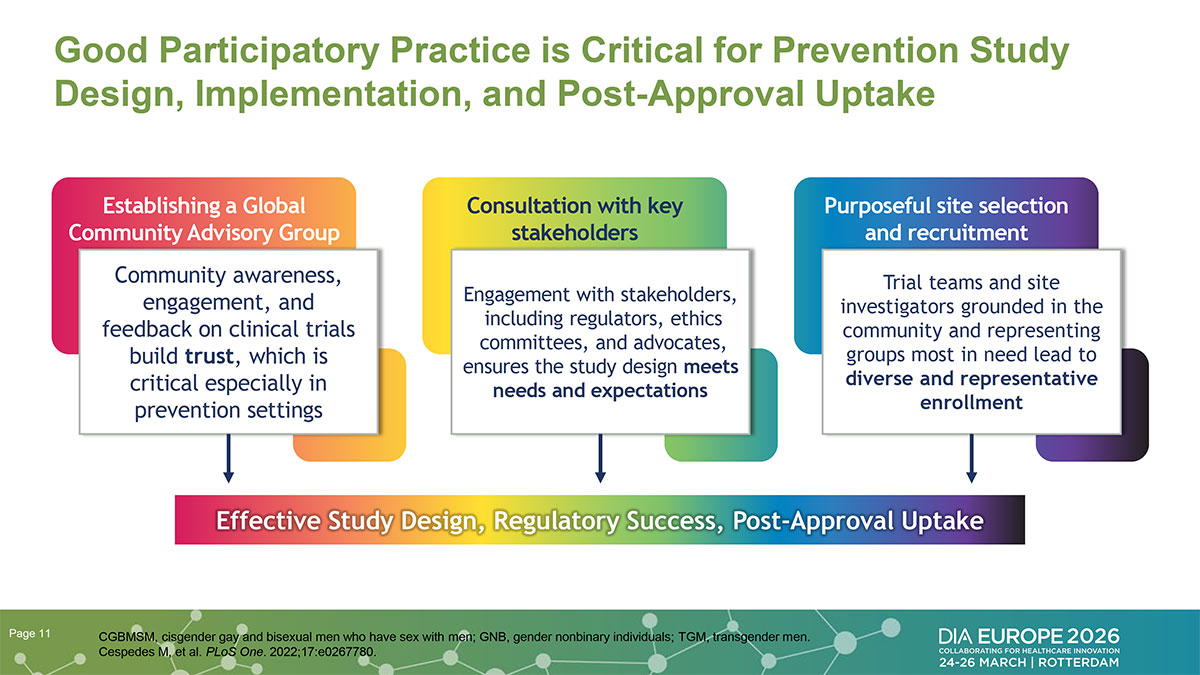
Demonstrating the safety and efficacy of preventive measures poses different challenges than those arising from testing a therapeutic medicine. Some of these hurdles have been overcome, but further creativity is needed. For example, vaccine trials typically include large sample sizes and are held to very high safety standards when intervening in a healthy population, while clinical development of HIV prevention therapies requires innovative study designs (see accompanying box).
Streamlined regulatory approaches for gaining acceptance of novel methodology and process are essential. This includes developing surrogate biomarkers as endpoints in clinical studies. Advances in diagnostics, wearables, in silico testing, AI, and other novel methods could generate data to reduce uncertainties in the development program. Early dialogue between investigators and regulators is to be encouraged and can foster a shared understanding of how to develop preventive interventions at scale.
Achieving Change in Challenging Times
Despite the benefits of prevention, real hurdles remain. Along with regulatory dialogue, product developers need a stronger signal that preventive products are desired and will be deployed. At present, across OECD nations, preventive health measures typically receive less than 3% of total healthcare spending. Access bodies and policymakers have a key role to play in shaping incentives that will drive investment in preventive health research and development.
At the same time, policymakers operate with finite resources, often within short-term, siloed budgets. This is a specific challenge for preventive measures that deliver benefits in the long term but require investment today. This contrasts with therapies or surgical services which typically use current account spending to treat a patient’s problem in the present. Similarly, preventive medicines funded through healthcare budgets may offer future savings in areas such as social services or provide benefits to the wider economy by keeping people in the workforce. This illustrates a disconnect between the source of funds invested and the subsequent gains.
Along with the uncertainties that accompany projected long-term benefits, behavioral research has consistently demonstrated a present bias whereby short-term therapeutic benefits are valued more highly than delayed preventive benefits. Even where a therapy does not deliver greater overall value than that offered by a preventive medicine, its impact is often more immediately visible in a given patient. Accumulating more data on prevention studies is worth our attention and may provide surprising future insights.
The introduction of Pre-Exposure Prophylaxis (PrEP) to reduce the transmission of HIV highlights some of the development and regulatory challenges that arise in preventive medicine. PrEP is given to HIV-negative people and significantly reduces their risk of acquiring HIV if exposed to the virus. Along with antiretroviral therapy (ART) that is given to HIV-positive individuals, these tools have made HIV less common where medicines are available and used as recommended.
Building on these successes, innovation in this field continues, including in medication adherence. For example, developers seeking to demonstrate the safety and efficacy of a long-acting injectable alternative to daily oral PrEP faced a range of technical, regulatory, and research ethics hurdles. To prove that the new product was better than the standard oral product, investigators would need to show that more patients developed HIV in the control arm of the study. This raised ethical questions as well as the prospect of having to run a lengthy study in a very large study population.
Researchers took a novel approach, drawing on counterfactual study designs previously used to estimate background pregnancy rates when testing contraceptive products. They also conducted a more traditional comparison with an existing product. Regulators evaluating the application for the new product based their approval on the traditional superiority study rather than the novel comparison used by investigators. This points to a need for regulatory acceptance of innovative study designs and flexible and pragmatic regulatory pathways while maintaining scientific rigor and patient safety.
Shifting Minds and New Incentives
Notwithstanding these hurdles, science is moving forward. This demands a collective effort to address psychological, cultural, and practical barriers in order to help build a prevention-focused health ecosystem. Not only should all stakeholders engage with the public and policymakers to support a more long-term view of protecting health, but we must also work together to ensure that research and development, regulatory, manufacturing, and access pathways and incentives are aligned with prevention.
Europe’s regulatory system has experience in adapting to meet an agreed goal. For example, the Orphan Medicines Regulation has had a transformative impact on the field of rare diseases. The Paediatric Regulation has increased research on children’s healthcare. Support for new antibiotics to help combat antimicrobial resistance (AMR), and ongoing stakeholder dialogue on innovative incentive models, show a capacity for fresh thinking to advance shared policy goals.
Europe also has a strong record of deploying public-private partnerships to clear bottlenecks in the system. The Innovative Medicines Initiative and its successor, the Innovative Health Initiative, have supported projects designed to develop digital endpoints, novel biomarkers, and data governance. These projects facilitate early engagement between academia, developers, and regulators that helps to shape regulatory science and, ultimately, promises to bring new solutions closer to patients.