



he Association of Southeast Asian Nations (ASEAN) Joint Assessment (AJA) is a voluntary, collaborative procedure that allows pharmaceutical companies to simultaneously submit a marketing authorization application for assessment to and by a minimum of three participating ASEAN National Regulatory Authorities (NRAs). The ASEAN JA framework was established in 2017 under the auspices of the Joint Assessment Coordinating Group (JACG) of the ASEAN Pharmaceutical Product Working Group, with technical advice from the World Health Organization (WHO). Several NRAs have included AJA as one of the formal registration procedures in their guidelines. Since its inception, several products across industries have been approved via the AJA pathway.
Pilot Architecture: The Coordination Model
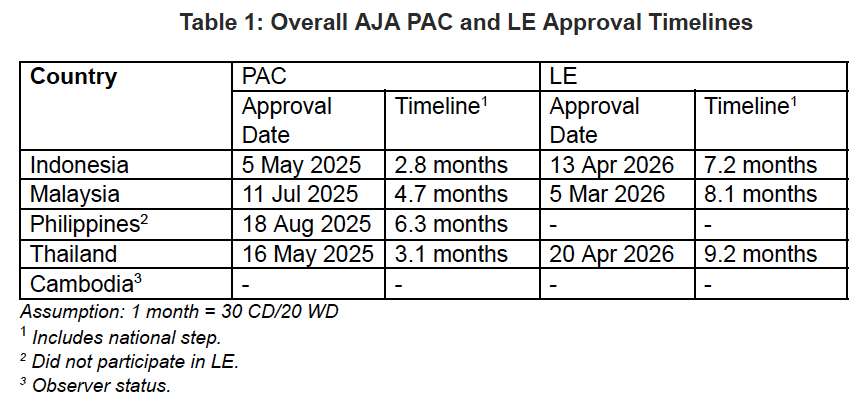
The pilot employed a centralized coordination model designed to minimize duplication and maximize scientific alignment. Malaysia’s National Pharmaceutical Regulatory Agency (NPRA) served as the Lead NRA, spearheading the joint scientific review (see Table 1 for all participating agencies). This regional effort was bolstered by strategic advisory support from Australia’s Therapeutic Goods Administration (TGA), which provided technical guidance to participating NRAs in a role facilitated by the WHO to provide mentorship.
The methodology relied on a sequential submission strategy to maintain a manageable workflow. The PAC dossier was submitted to and assessed first by all participating NRAs, followed by the LE application. Communication with NRAs was centralized through the Joint Assessment Information Management System (JAIMS), a platform used by the sponsor’s single coordinating affiliate to manage submissions and query responses. The workflow spanned from October 2024 through February 2026, a duration that the sponsor considered reasonable, and transitioned from a collaborative assessment into a national phase where each NRA issued final approvals.

Measuring Success: Timelines and Efficiency
The AJA framework performance was evaluated against Key Performance Indicators focused on review speed and scientific alignment:
- Total approval timelines, including the national phase.
- Number of consolidated AJA questions versus national queries.
- The extent of requirement waivers and cross-border alignment.
- Overall operational gains via centralized coordination.
Table 1 also outlines that PAC approvals were finalized between May and August 2025, and LE between March and April 2026. While the AJA significantly improved timelines in most countries (Figures 2-3), Indonesia’s PAC approval still required 2.8 months (versus the standard 2.0 months) via the AJA pathway (Figure 2). This delay highlights a regulatory disconnect in Indonesia’s “Dual-Review Scenario.” The absence of a formal AJA procedure in Indonesia resulted in parallel processing, which ultimately negates the efficiencies typically gained through collaborative procedures. Significant improvements were also observed in Malaysia, where PAC approval timelines were reduced from 11.8 months via the national procedure to 4.7 months (60%) under the AJA. This momentum carried through to LE, where overall timelines also decreased under the AJA pathway in all participating NRAs. For example, in Indonesia, the decrease was 7.2 months (52%).
Efficiency was further evidenced by a reduction in queries; as shown in Table 2, the Philippines and Thailand received no additional questions from their respective NRAs during the national stage for PAC.


Regional Case Studies: Navigating Local Landscapes
Malaysia
As the Lead NRA, Malaysia’s reference to both TGA and EMA (i.e., dual-assessment reports) provided insights into the critical challenges associated with such an approach. During the national phase, the review incorporated queries from a secondary reference agency alongside the AJA framework. Moving forward, prioritizing a single primary reference agency assessment report would further reduce query burden and technical duplication.
Philippines
The Philippines Food and Drug Administration (PFDA) demonstrated the most significant efficiency gains. By utilizing the AJA pathway, the PFDA shortened the PAC approval timeline to 6.3 months, an acceleration from the 9-month standard. Most importantly, they fully accepted the joint assessment findings without issuing separate national queries, demonstrating true operational reliance.
Thailand
Thailand’s participation was built on a strong foundation; its national pathway for biologic PACs already aligns with European Medicines Agency (EMA) and WHO variation guidelines.
Indonesia
The sponsor’s experience with Indonesia highlighted the need for regulatory formalization. Because collaborative pathways are not yet integrated into Indonesia’s national guidelines, the NRA conducted a full local review in parallel with the joint assessment, which led to a different timeline between local versus AJA. The specific local timeline is 4.7 months for LE and 1.6 months for PAC.

Regulatory Convergence and Reliance
The pilot proved that the AJA framework can successfully drive regulatory convergence. Participating NRAs displayed increased alignment in scientific conclusions, leading to waiving of specific local requirements (e.g., post-change Certificates of Analysis) and reducing duplication by placing greater trust in the Assessment Report generated by the reference agency.
Furthermore, the “Strategic Advisory Support” model proved invaluable. The TGA’s mentorship, facilitated by the WHO, allowed the Lead NRA to demonstrate independent capability while benefiting from international peer-to-peer support, building the expertise necessary to sustain a long-term reliance-based ecosystem.
Recommendations for the Road Ahead
To transform the AJA pathway into a sustainable, lifecycle management procedure, five core actions are recommended:
- Formalize AJA in National Regulations: NRAs must integrate AJA as a recognized national pathway to eliminate “dual-track” evaluations and resource-heavy parallel reviews.
- Optimize Digital Workflows: Transition to a more efficient digital standard to reduce duplication of effort.
- Adopt a Unified Primary Reference Framework: NRAs should agree to prioritize a single primary reference authority to avoid the complexity of including queries from the secondary reference agency during the local approvals.
- Harmonize Variation Guidelines: Maintain continuous alignment with international standards (such as the EMA and WHO) to prevent change classification inconsistencies.
- Formalize Advisory Engagement Mechanisms: Establish structured pathways via the WHO for strategic advisors to ensure consistent mentorship during complex evaluations.
Ultimately, expanding the AJA framework from initial approval to lifecycle management is a vital step toward a harmonized regulatory environment, ensuring faster, more predictable access to life-saving medicines across ASEAN.
Acknowledgements
The authors extend their appreciation for the support and contributions provided to this pilot and the development of this article by Ehab Taqieddin, Srinivasan Kellathur Nadathur, Suat Gnoh Por, Ran Zhang, Fedina Devi Valentina, Jinwara Srisunacua, Robelle Benemerito, Joanna Waugh, Lauren Lord, Monica Habib, and Win Nie Lee.