



DIA RIM Reference Model Version 2.0
ver the last two decades, regulatory affairs has undergone a fundamental transformation, shifting from a document-centric to an increasingly data-driven discipline. Historically, critical activities such as product registrations, submissions, and health authority interactions were managed through disparate spreadsheets or home-grown tools. This fragmentation has made collaboration, interoperability, and system integration a persistent challenge. However, as global regulatory requirements expand in both scope and complexity, these traditional methods have become unsustainable.
In response to these challenges, the DIA RIM Working Group released the DIA RIM Reference Model Version 1.0 (V1.0) in July 2022, which established an industry-aligned framework for harmonizing regulatory processes and a high-level vocabulary of data objects based on regulatory needs. While socializing the model, the working group realized that V1.0 of the model was complex and not readily usable by RIM vendors or drug sponsors due to the way it was structured as a single Excel worksheet. In April 2026, the DIA RIM Working Group released the DIA RIM Reference Model Version 2.0 (V2.0), a framework designed to harmonize terminology, data structures, and process definitions across the regulatory landscape. V2.0 significantly expands on the earlier foundation, reflecting years of industry collaboration and practical implementation experience into a more formal data model. What was in a single worksheet in V1.0 was transformed into a workbook of multiple worksheets, representing objects and relationships around RIM processes and data.
Implementing this robust, harmonized data model along with standardized processes will help support Regulatory Information Management as a strategic capability to streamline the regulatory value chain and achieve regulatory operational excellence.
What’s New in Version 2.0
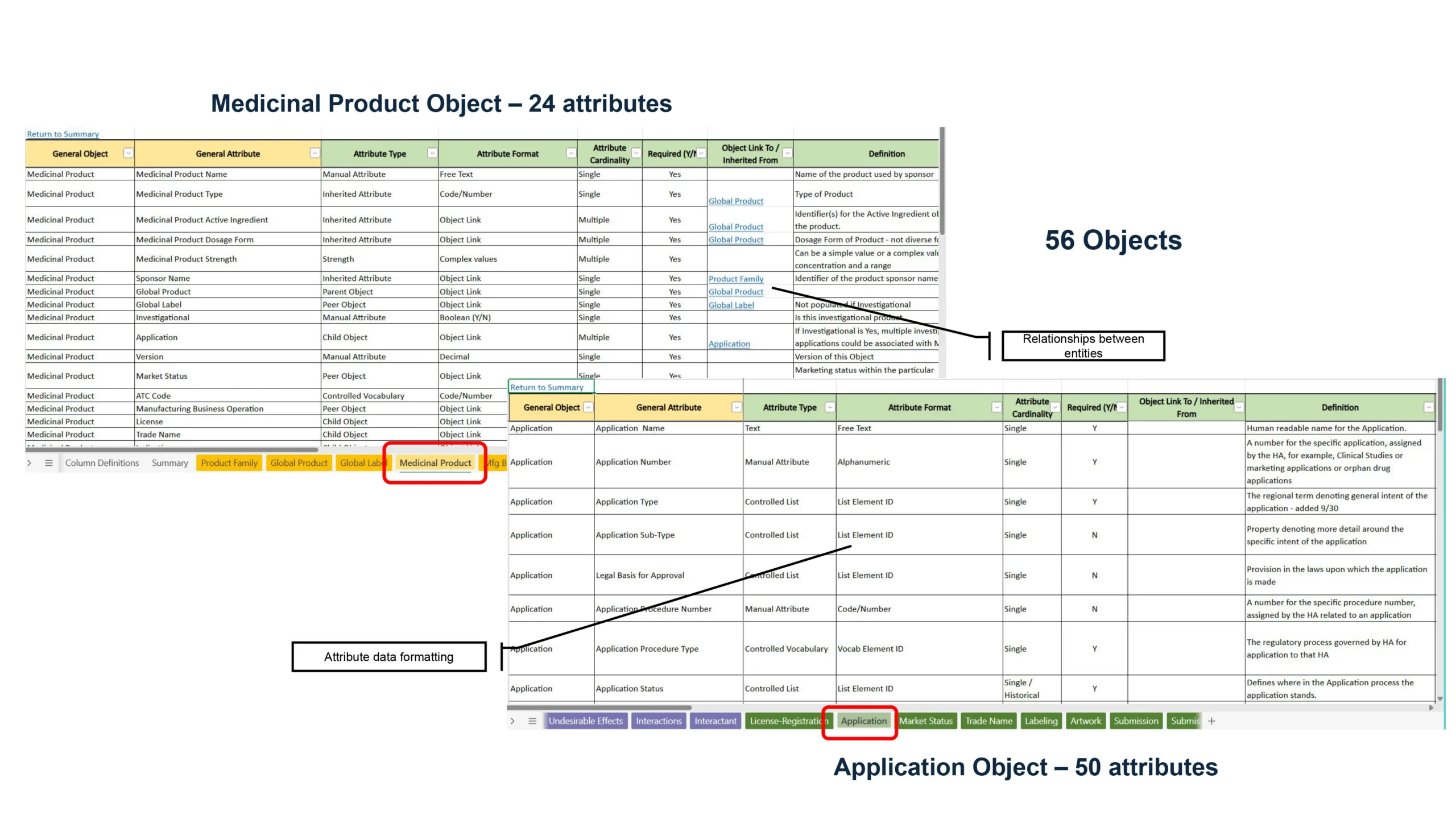
V2.0 expands and operationalizes the model started with V1.0 through a structured set of 56 business entities (or objects), including attributes and relationships which mirror regulatory activities under the following domains:
Product Objects
- Product Family, Global Product, Medicinal Product, and Global Label manage information related to the product portfolio.
- Pharmaceutical Product Detail, Product Components, Ingredient, Substance, Shelf Life/Storage, Packaged Product, and Physical Characteristics manage details around a specific product.
- Clinical Particulars capture information on indications, contraindications, undesirable effects, and interactions for a specific product.
Regulatory, Commercial, and Manufacturing Objects
- Application, License-Registration, Market Status, Trade Name, and Labeling manage the lifecycle of regulatory filings and approvals for a specific product.
- Submission, Submission Content Plan, Submission Content, and Content manage data around document and submission management for a specific product.
- Manufacturing Process and Operations manage data around production activities, sites, and process steps for a specific product.
Process and Interaction Objects
- Process Objective, Process Plan, and Process Step define regulatory strategies and execution pathways for a specific product.
- HA Correspondence, HA Q&A, HA Meeting, Commitment, and Inspection cover the interactions with health authorities and scheduled tasks for a specific product.
Organizational Objects
- Organizations, Sites, and Contacts manage information on sponsors, health authorities, and operational entities.

The Figure above shows the high-level conceptual model of V2.0. The Table below shows a partial snapshot of the Application Object tab. Click on either image to view full-size.
Benefits
The practical applications of the DIA RIM Reference Model V2.0 serve as a strategic “starter kit” for organizations working to move their regulatory data from a collection of isolated documents into a structured, enterprise-level data asset, and an enabler for integrated data exchange across its regulatory ecosystem, including the clinical, manufacturing, quality, safety, and commercial functions. Its implementation provides a blueprint for consistency, automation, and cross-functional alignment and provides the backbone upon which sponsors and technology vendors can architect RIM implementations and products that support the full regulatory lifecycle, from investigational products to post-approval commitments, whether home-grown or vendor offerings.
Streamlining RIM Implementations
For organizations launching or upgrading their RIM system, the model acts as a foundational architecture to drive configuration requirements, addressing the following objectives:
- Reduced Development Time
- Best Practice Alignment
- Scalability
Accelerating Migration and M&A Efforts
During mergers and acquisitions or system migrations, V2.0 serves as a “neutral ground” for aligning disparate data sets through:
- Standardized Mapping
- Reduced Redundancy
- Harmonization Blueprint
Data Standardization and Governance
V2.0 establishes a comprehensive data dictionary that serves as the “source of truth” for regulatory data including:
- Consistent Taxonomy
- Formal Governance Structure
- Master Data Management (MDM).
Interoperability Across Applications and Functions
V2.0 is designed to facilitate seamless information exchange across the product lifecycle. The DIA RIM Reference Model V2.0 User Guide provides implementors with guidance on building systems that include the following capabilities:
- Cross-Functional Data Exchange
- International Standards Alignment
- Foundation for Automation
Comparison: DIA RIM Reference Model V1.0 vs. V2.0
The transition from the V1.0 framework described in July 2022 to the V2.0 User Guide represents a significant maturation of the model, shown in the Table below:
and relationships
and usage contexts
Summary and Invitation
The DIA RIM Reference Model V2.0 elevates regulatory information management from an administrative necessity to a strategic asset with a comprehensive and mature data model. By providing a common taxonomy and data dictionary, it is our belief that it will enable the industry to achieve compliance with greater precision and speed. We hope widespread adoption, experience, and feedback will validate our position.
The following deliverables (or artifacts) related to V2.0 can be found on the DIA Website under Tools and Downloads along with testimonials from two RIM product vendors:
- DIA RIM Reference Model V2.0 Conceptual Model (PDF download)
- DIA RIM Reference Model V2.0 Workbook (Excel download)
- DIA RIM Reference Model V2.0 User Guide (PDF download).
As organizations continue to transform, modernize, and expand the scope of their regulatory operations, adoption of the DIA RIM Reference Model Version 2.0 offers a clear and strategic pathway toward standardized data, efficient processes, and integrated digital regulatory ecosystems, enabling faster, more compliant, and more informed delivery of therapies to patients worldwide.
Organizations and individuals downloading these artifacts for RIM requirements analysis or implementation efforts can reach out to the authors and representatives of the DIA RIM Working Group to further understand the model or to provide feedback. The DIA RIM Working Group continues to invite sponsors and technology vendors to adopt, validate, and contribute to the continued evolution of the model.
To learn more about this and related topics, plan to attend our Regulatory Submissions, Information, and Data Management Forum.