



Around the Globe: Singapore
On Behalf of the SAPI Regulatory Affairs Committee, Innovation Working Group
he Singapore Association of Pharmaceutical Industries (SAPI), which recently celebrated its 60th anniversary, represents research-based biopharmaceutical companies in Singapore and serves as a platform for constructive engagement among industry, regulators, and other healthcare stakeholders. A key partner in this ecosystem is Singapore’s Health Sciences Authority (HSA), which marked its 25th anniversary in 2026.
A Modern, Risk-Based Regulatory System
From the Singapore-based industry perspective, the past decade (2016-2026) has been particularly significant, marked by regulatory innovation, international collaboration, and close regulator-industry engagement that have supported timely access to innovative health products.
While Singapore is a relatively small domestic market, it serves as a leading regional hub for pharmaceuticals, biotechnology, and medical technology. More than 60 biopharmaceutical manufacturing facilities operate in Singapore, producing a broad range of products, including active pharmaceutical ingredients, biologics, cell therapies, and antibody-drug conjugates. With biopharmaceutical industry output exceeding S$18 billion in 2023, Singapore has developed a strong ecosystem that supports close regulator-industry collaboration and regulatory innovation. Consistent with this environment, Singapore’s regulatory environment for health products has evolved from a product-specific framework into a more integrated, risk-based, lifecycle-oriented system. This evolution has strengthened regulatory predictability and enabled more efficient oversight across the product lifecycle.
The establishment of the Health Products (Therapeutic Products) Regulations 2016, which brought the regulation of pharmaceutical products under the Health Products Act, marked one key milestone. Consolidating registration, licensing, and supply-chain controls within a single legislative framework created a more integrated regulatory model and provided greater clarity across the product lifecycle.
As HSA’s regulatory approach has matured, assessment and oversight of pharmaceutical products have become progressively more risk-proportionate with continuous refinement of registration requirements to streamline processes, improve predictability, and clarify documentation expectations. One notable example was the expansion in 2022 of post-approval changes permitted under the MIV-2 “Do-and-Tell” notification pathway, following optimization of the variation checklist. This reform demonstrates HSA’s continued efforts to calibrate regulatory oversight according to product risk, reduce unnecessary regulatory burden, and support more efficient lifecycle management.
HSA has also developed fit-for-purpose regulatory frameworks and guidance for emerging technologies, including cell, tissue, and gene therapies, software as a medical device, digital health products, AI-related tools, and laboratory-developed tests (Table 1). These initiatives demonstrate HSA’s commitment to ensuring that regulatory requirements continue to evolve alongside scientific and technological advances.
Table 1: Key Regulatory Initiatives, 2016–2026.
2021
2026
Therapeutic Products Regulations 2016
Digital health and software medical device framework
2017-2020
2021
2021
2026
Singapore’s Stronger Global Regulatory Partnerships
HSA’s international collaboration is an important enabler of Singapore’s pharmaceutical ecosystem and can support more timely access to innovative health products. HSA has achieved World Health Organization (WHO) maturity level 4 (ML4) status and has subsequently been designated a WHO-Listed Authority (WLA) for Medicines in 2022 and 2023 respectively. (FDA, EMA, TGA, and PMDA became WLA later than HSA, and they went through an abbreviated assessment.) More recently, HSA was the first regulator to achieve the highest WHO maturity level 4 through a comprehensive assessment by WHO in 2026. The WHO benchmarking framework evaluates regulatory authorities against over 260 indicators and is on a voluntary basis. This demonstrates HSA’s willingness to be benchmarked against global standards. (See Figure 1.) HSA is recognized as a reference authority by a growing number of regulators. For Medicines, this includes Australia, Brunei, Egypt, Hong Kong, Philippines, South Africa, Switzerland, the United Kingdom, and Uzbekistan. This facilitates expedited registration pathways for products that have received HSA’s approval.
Figure 1: HSA’s international recognition as a robust regulatory agency
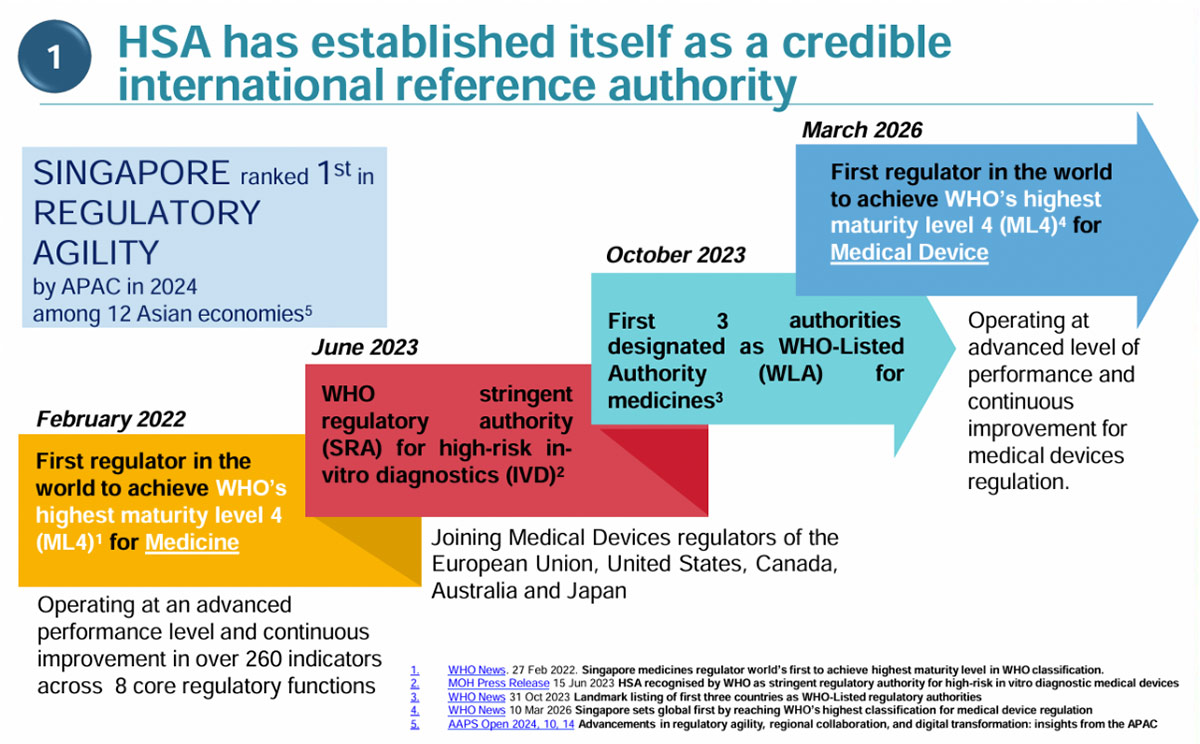
At the regional level, HSA participates in the ASEAN Joint Assessment Procedure for Pharmaceutical Products, through which member states conduct simultaneous, coordinated assessments of the same marketing authorization application. For companies seeking registration across multiple ASEAN markets, this can reduce duplication of effort and support more consistent outcomes across the region.
In addition to multilateral platforms and regional mechanisms, HSA has also built strong bilateral partnerships and has more than 20 active memoranda of understanding (MoUs) with regulatory authorities globally (see Table 2 below). These formalize regulatory agencies’ commitments for partnerships and broaden opportunities for information sharing, capability building, joint initiatives, and regulatory innovation.
The UK-Singapore Regulatory Innovation Corridor is particularly significant for industry in terms of facilitating access to innovative products between these two markets. While still in pilot phase, its promise for coordinated early engagement with both HSA and the UK’s Medicines and Healthcare products Regulatory Agency (MHRA) can help developers anticipate requirements, improve development plans, and avoid unnecessary delay for breakthrough technologies.
Table 2: Bilateral agreements signed by HSA in 2026
For industry, this growing network has significant practical implications. Singapore’s integration into global and regional regulatory frameworks means that HSA assessments are increasingly recognized and leveraged by other authorities. This engagement can support more efficient inspections, clearer regulatory pathways, and earlier scientific dialogue, reduce duplication, and support more efficient multimarket registration strategies for applicants. Companies engaging with HSA can do so with confidence that its standards are internationally benchmarked and that its relationships with peer regulators continue to grow.
The Value of Regulator–Industry Partnership
Over the years, HSA and SAPI have established a strong partnership founded on a shared commitment to public health, timely patient access to innovative medicines and vaccines, and regulatory excellence. A key strength of this partnership is the regular engagements between the SAPI Regulatory Affairs Committee (RAC) and HSA, which provide a platform for dialogues on regulatory developments, implementation challenges, and opportunities for continuous improvement. More recently, SAPI RAC collaborated with HSA in the Health Products Regulatory Conference BioPharma Day 2025, bringing together regulators, policymakers, and industry representatives to exchange perspectives on regulatory science, artificial intelligence in regulatory affairs, advanced therapies, and submission excellence.
Within SAPI RAC, several working groups facilitate structured engagement on emerging regulatory topics with HSA. Through consultations on policies, guidelines, and implementation experiences, these groups provide industry feedback to support practical regulatory solutions. A notable example is the close collaboration between SAPI RAC and HSA in reviewing and optimizing the variation guidelines and checklists to ensure they remain aligned with evolving international regulatory practices. The working groups have also contributed to discussions on digitalization initiatives such as e-labeling and eCTD implementation, as well as emerging regulatory frameworks for innovative treatments such as cell and gene therapies.
SAPI contributes to international regulatory collaboration beyond Singapore through its participation in the network of pharmaceutical industry trade associations across the five Access Consortium member countries. Together with its international counterparts, SAPI engages Access Consortium regulators and provides industry recommendations through position papers to strengthen collaborative review pathways, particularly the New Active Substance Work-Sharing Initiative (NASWSI). These efforts support greater transparency, predictability, and regulatory convergence, and contribute to the continued development of the Access pathway to facilitate more timely access to innovative medicines. Within ASEAN, SAPI is actively involved in ASEAN pharmaceutical harmonization at the Implementation Working Group under the ASEAN Pharmaceutical Product Working Group where SAPI is currently the chair of the ASEAN Pharmaceutical Research Industry Association.
The value of such international collaboration was further demonstrated through SAPI’s engagement with HSA and the International Federation of Pharmaceutical Manufacturers & Associations (IFPMA) during the ICH Assembly held in Singapore in November 2025. The engagement brought together HSA, industry leaders, and IFPMA representatives to exchange perspectives on ICH guideline development, HSA’s ICH implementation journey, and opportunities for collaboration. One example is the revised ICH E6(R3) Good Clinical Practice guideline: ahead of its implementation in Singapore on 1 January 2026, SAPI members took part in HSA-led training, workshops, and stakeholder engagement sessions. These initiatives strengthened regulator-industry alignment and supported the effective adoption of internationally harmonized standards.
Looking Ahead: Building on a Strong Foundation
HSA has played a pivotal role in shaping a modern, robust, predictable regulatory environment in Singapore. For industry, one of the most significant developments has been the growing availability of international collaborative pathways such as the Access Consortium and Project Orbis, which enable companies to pursue earlier, more coordinated medicine launches across multiple countries.
As regulatory pathways have evolved, proactive planning and agile regulatory strategies have become increasingly important for improving efficiency, optimizing submission sequencing, and maintaining compliance throughout the product lifecycle.
Looking ahead, there are opportunities to build on HSA’s WHO maturity level 4 and WHO-Listed Authority status to strengthen international partnerships and translate collaboration agreements into transparent, scalable, measurable facilitated pathways. Industry sees particular value in establishing clear eligibility criteria, aligned submission windows, predictable timelines, mechanisms for confidential information exchange, consistent post-approval requirements, and regular regulator-industry dialogue. Industry can, in turn, support implementation by sharing operational experience, identifying practical challenges, providing technical expertise, and encouraging use of collaborative pathways where appropriate. These efforts can strengthen regulatory capacity, build trust among authorities, reduce unnecessary administrative burden, and reinforce Singapore’s position as a launch and innovation hub. Continued regulator–industry engagement will be important to realize these benefits while maintaining high regulatory standards and supporting timely access to safe, effective, innovative health products.
Singapore’s experience demonstrates how sustained collaboration between regulators and industry can strengthen public health, support innovation, and improve access to safe and effective medicines. Building on the strong foundations established over the past 25 years, continued partnership between HSA and industry will be central to shaping the next chapter of Singapore’s regulatory development.