



Lilly China Drug Development & Medical Affairs Center
ver the past decade, China’s pharmaceutical research and development (R&D) has been significantly transformed. Systemic regulatory reforms launched in 2015—including clinical trial licensing, rolling submissions, and expedited approval pathways—sharply accelerated development timelines and released a wave of domestic innovation.* China has emerged as a major source of global pharmaceutical innovation, accounting for nearly half of new drug molecules entering human trials in the first half of 2025. At the same time, domestic developers have achieved several world-first approvals in novel therapeutic modalities, reflecting China’s transition from a fast follower to an increasingly important innovation contributor.
Methodology: Clinical development timelines for local companies are defined by approval dates in China; multinational company timelines are defined based on the date of first global approval.
Overall Comparison: Local Companies vs. MNCs
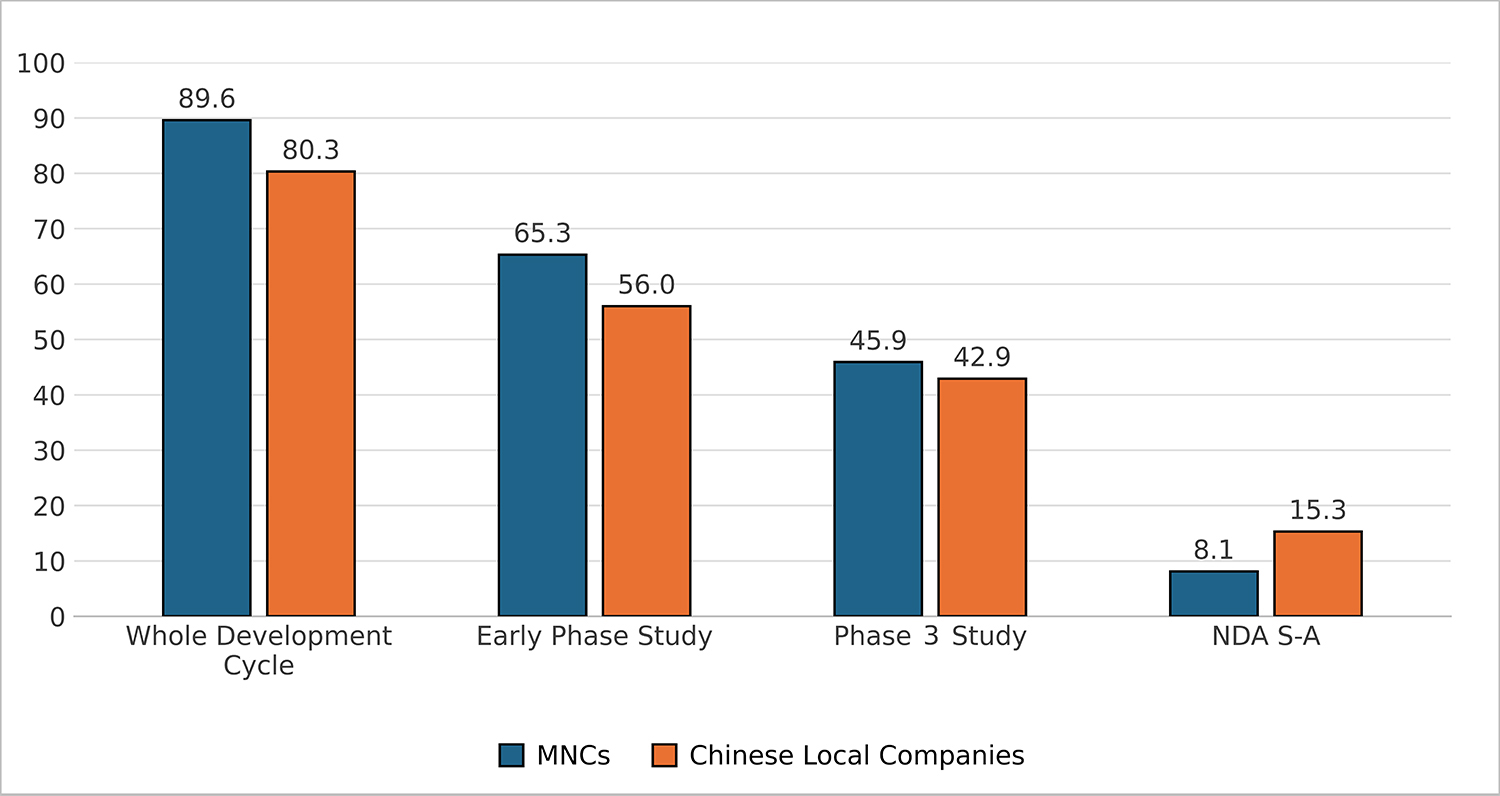
Local companies hold a clear early-stage lead: Their median 37.8 months from IND to the start of pivotal trials compares to 56.5 months for MNCs from 2023-2025; this gap has widened to 18.7 months from 9.3 months in 2020-2022. In phase 3, the two are essentially level at about 34 months each.

Performance of Leading Compounds
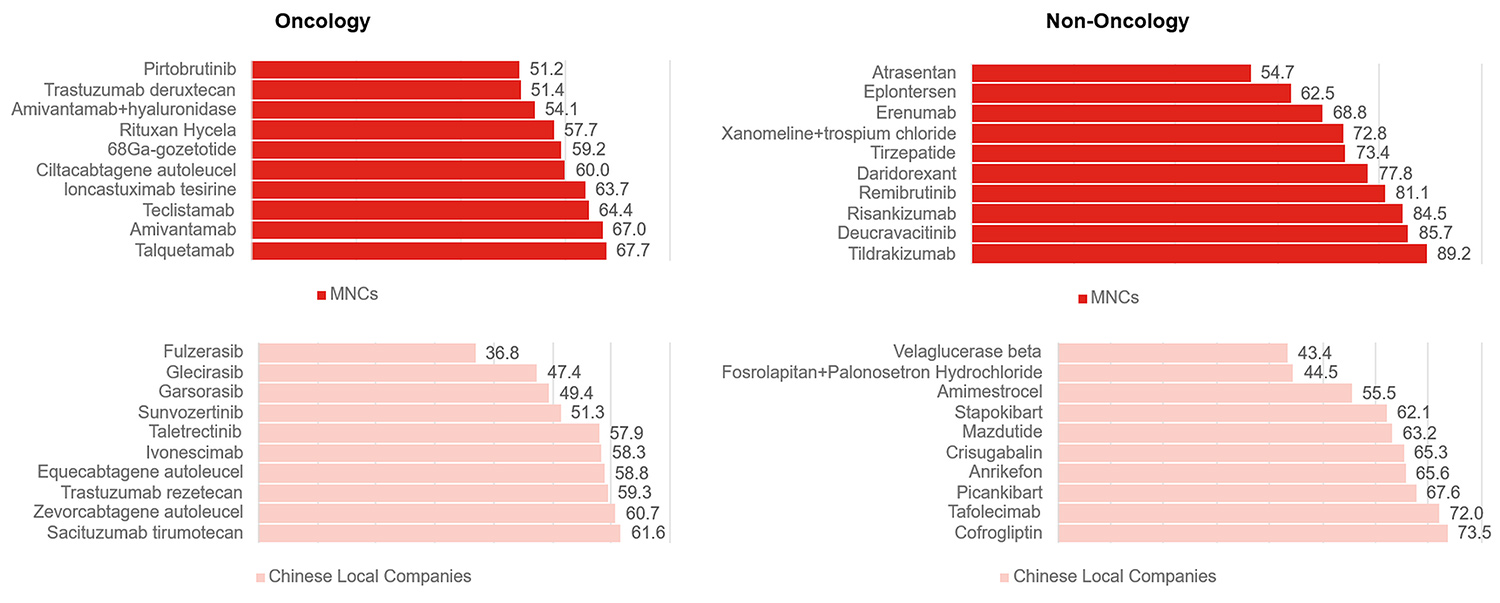
The top 10 fastest developed compounds (the 10 approved products with the shortest development cycles, as explained above) in China and global markets represent the peak development velocity for both groups (Figure 3 and Figure 4). Efficiency in the overall cycle has reached parity within this highest performance tier. In oncology, leading assets from MNCs achieve an overall development timeline of 51.2 months, while leading local companies further compress it to 36.8 months. Overall, oncology demonstrates higher development efficiency than non-oncology therapeutic areas. This suggests that in indications with high unmet medical needs, stronger regulatory support, and more focused endpoint design, speed advantages are more readily amplified and translated into competitive advantage.
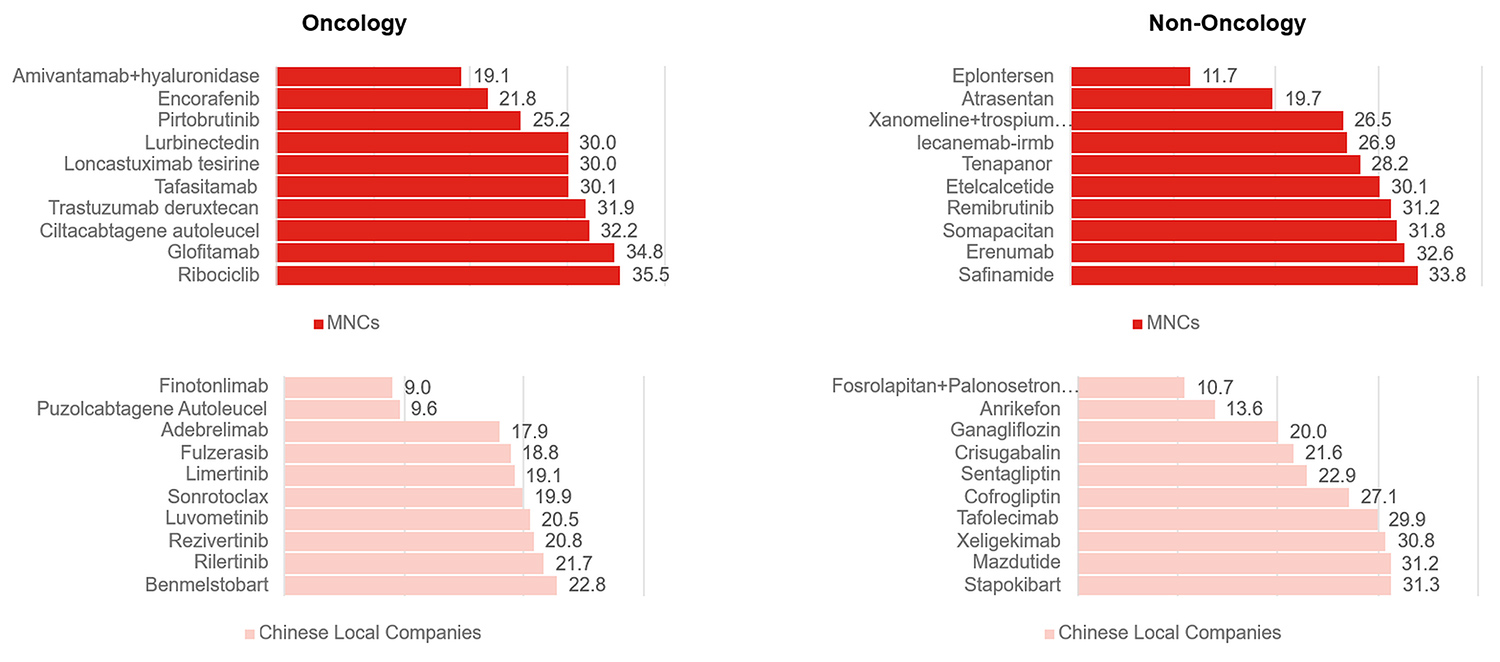
Local companies maintain a pronounced velocity lead in early-phase oncology studies. The most accelerated local asset (finotonlimab) completed its early-phase development in just nine (9) months, outperforming the fastest MNC project by approximately 10 months, as the latter required 19.1 months to reach the same milestone. This gap reflects not only faster execution, but also efficiency in project decision-making, trial design, regulatory engagement, and resource coordination. In contrast, local companies show little acceleration advantage over MNCs in early-stage non-oncology development.
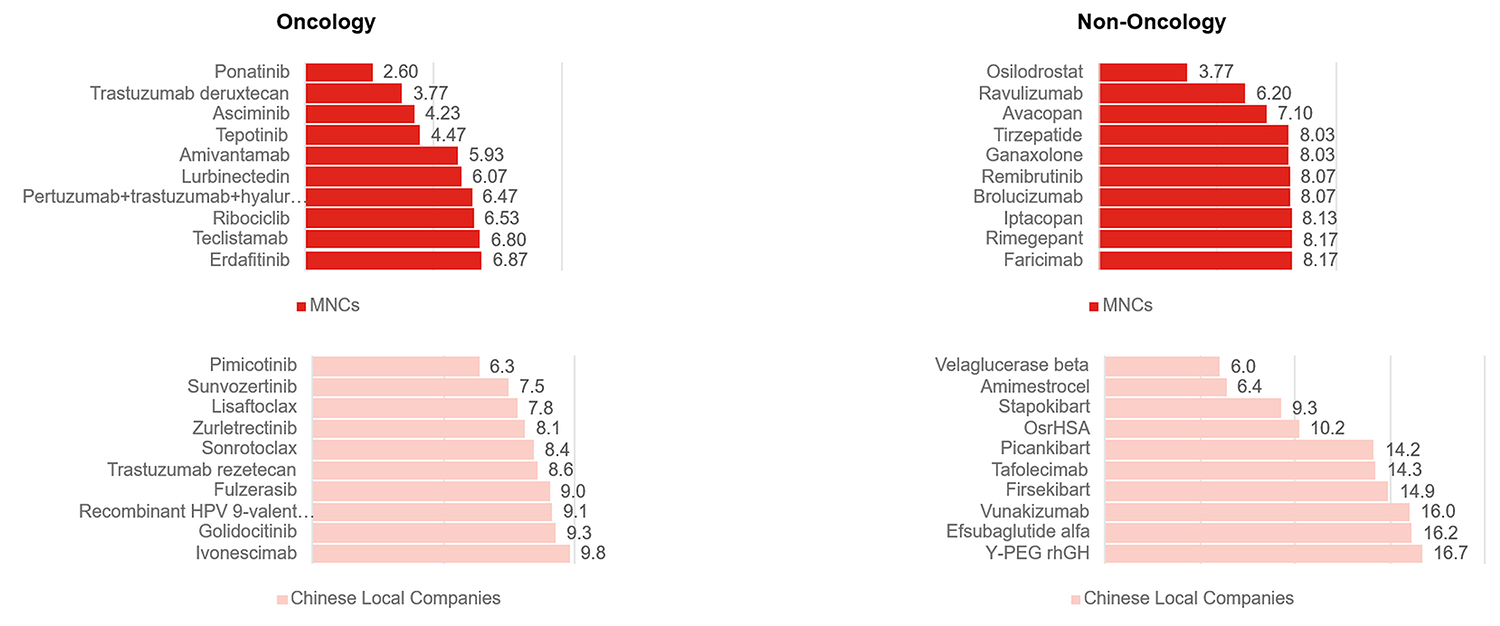
MNCs demonstrate superior speed and certainty from NDA submission to approval. This advantage is particularly pronounced in oncology, where the fastest MNC project achieved approval in just 2.6 months, compared with 6.3 months for the fastest local projects. Meanwhile, oncology products generally experience shorter approval timelines than non-oncology products.
Overall, local companies are raising expectations for early-stage execution, while MNCs continue to define standards in global development and regulatory excellence. Future leaders will be those that combine the best of both models—speed, scientific rigor, and global evidence generation—to deliver breakthrough therapies to patients faster.
Key Factors Driving the Performance Gap
Analysis of leading cases points to three drivers behind the local companies’ early-stage speed: aggressive early regulatory strategies, flexible execution, and a decisive shift to in-house clinical operations. Together they explain the early-phase agility—and the contrast with MNC operating models.
- Full use of policy advantages and calculated early clinical risk. For Class I innovative products with a globally validated Mechanism of Action (MoA), local companies fully exploit China’s regulatory pathways and adopt more aggressive early designs, including single-arm and seamless phase 1/2 studies. In oncology, these designs accelerated approvals well beyond the traditional parallel or placebo-controlled studies that MNCs favor for global data consistency.
- Accelerated execution through flexible local processes. Local companies bypass the protracted global review cycles typical of MNCs, using streamlined procedures for generating site contracts and Clinical Study Reports (CSRs). Some local models let early-phase Investigator-Sponsored Trials (ISTs) reach a “Go or No-Go” decision in as little as three days and finalize protocols within 1–2 months, whereas MNCs often need an added 2–4 weeks to satisfy global Standard Operating Procedure (SOP) requirements and internal approvals.
- Established in-house clinical operations and greater investment. Leading local companies have scaled internal teams that run a high share of their trials, gaining a 10%–30% speed increase over external Contract Research Organizations (CROs) through deeper product understanding and cross-functional coordination. MNCs are gradually building local teams too, but the aggressive resource scaling of local developers continues to drive their early-stage advantage.
These patterns reflect different strategic bets on speed versus regulatory rigor. For local industry, faster early phases are a market-entry advantage: by combining efficient decision-making with calculated risk-taking, they prioritize early regulatory engagement and positioning, laying the foundation to capture global first-in-class opportunities.
Crucially, this pursuit of speed must not compromise clinical rigor or data quality—and here the consistent performance of MNCs sets the industry benchmark. Their longer entry timelines largely reflect the complexity of Multi-Regional Clinical Trials (MRCTs) and alignment with diverse regulatory requirements across markets, including primary launch regions such as the US; in return, robust protocols and high-quality execution deliver greater certainty at final approval.
Outlook
The speed dynamics between local companies and MNCs show that development efficiency is now a core component of competitive advantage—and a vital lever for addressing unmet clinical needs.
As China establishes itself as a pioneering global R&D hub, both local and multinational companies can turn localized strengths—clinical flexibility and regulatory support—into synchronized global development. Integrating region-specific regulatory advantages can convert early-phase momentum into a sustainable competitive edge.
Ultimately, this alignment translates innovation into earlier market presence and greater product value, underscoring the decisive role of R&D and registration velocity on the global stage.