



PharmCube
hina’s innovative drug business development (BD) transactions continued gaining momentum throughout 2025, again breaking records across all dimensions for outbound deals. Data from PharmCube’s NextBiopharm® database shows that the total annual transaction value soared from USD 51.9 billion to USD 135.7 billion, while upfront payments reached USD 7.0 billion, and activity jumped from 94 to 157 transactions. These figures reflect the new level of development of China’s pharmaceutical industry as part of the global innovation landscape.
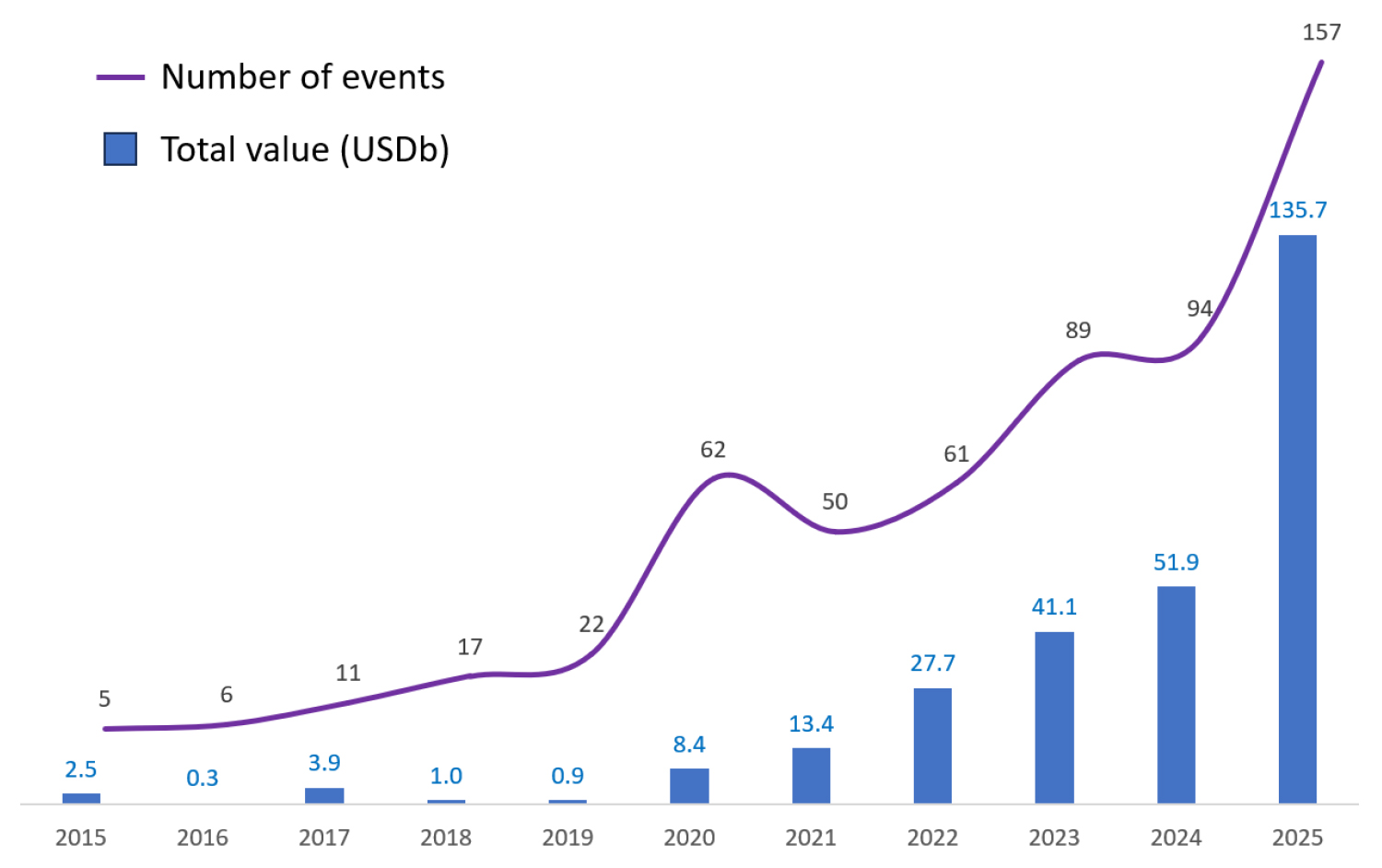
Source: PharmCube NextBiopharm® database.
Note: Figures only include transactions related to innovative drugs and technology platforms. Transactions involving traditional Chinese medicines, preventive vaccines, generics, improved new drugs, and biosimilars are excluded. Transaction values are based solely on publicly disclosed data. Statistics include data from Mainland China only and exclude Hong Kong, Macau, and Taiwan.
Upfront and Milestone Payments Bring Oxygen to Chinese Developers
According to PharmCube’s analysis, four China-outbound licensing partnerships triggered milestone payments in 2025. This is not an isolated phenomenon and confirms the perceived or expected value of Chinese innovative drugs.
Milestone payments not only supplement pharma companies’ cash flow and alleviate the R&D funding pressure, but more importantly, they also promote global product development. From another perspective, these milestones were mostly paid one to two years after deal signing, demonstrating China’s innovation efficiency.
These milestones concentrate around clinical progress and regulatory approvals. As a first example, in June 2025, the China marketing authorization for the Orpathys (savolitinib) + Tagrisso (osimertinib) combination in a specific lung cancer population triggered a USD 11.0 million milestone payment to the Chinese developer from the partner responsible for the commercialization of both products in China.
In July, the Chinese developer received a USD 10.0 million milestone payment from its partner after its PD-L1×VEGF bispecific antibody (BsAb) IMM2510/AXN-2510 got cleared for phase 1 trials in the US.
In the same month, the Chinese developer received a USD 300 million milestone payment from an out-licensing collaboration regarding LM-299/MK-2010, a PD-1×VEGF BsAb.
In the fourth example, in November, the wholly owned Chinese subsidiary received USD 250 million under a global strategic collaboration agreement for izalontamab brengitecan, marking the largest single milestone payment disclosed to date for an individual China-outbound antibody-drug conjugate (ADC). This relationship dates back to 2023, when this Chinese subsidiary granted this same partner an exclusive license for the potential first-in-class EGFR×HER3 bispecific ADC for up to USD 8.4 billion, including a sizeable USD 800 million upfront payment that showcased the confidence and commitment of both parties.
The upfront and milestone payment maturation period for China’s outbound drug transactions began in 2024, when one Chinese developer received USD 75 million related to the clinical progress of TROP2 ADC sacituzumab tirumotecan; another collected USD 60 million for the clinical advancement of small-molecule GLP-1R agonist elecoglipron; and a third triggered a USD 20 million payment linked to fruquintinib sales.
Such cases are expected to be more frequent as out-licensing activity reaches new highs, boosting the global market’s trust towards China’s innovative drugs, helping more domestic developers secure overseas BD collaborations, and keeping the industry’s focus on clinical value-oriented innovation.
From NewCo to Co-Co: The Path to Internationalization
While the records for highest valuation, upfront payment, and milestone payment are constantly broken, different collaboration models have emerged for China’s BD transactions.
If NewCo—a newly formed company created to house a specific set of assets—was one of the buzzwords in 2024, then Co-Co (co-development and co-commercialization) was the key term in 2025.
When a Chinese developer announced its licensing deal valued at up to USD 11.4 billion in October 2025, the largest single transaction in the history of China’s pharmaceutical BD, the discussion surrounded the Co-Co model of the partnership. While the agreement covers PD-1×IL-2α-bias BsAb IBI363 and two ADC assets, the companies pledged to co-develop IBI363 globally, share development costs at a 40/60 ratio (licensor/licensee), and co-commercialize the product in the US market, sharing profits and losses at the same ratio.
According to this developer, this collaboration will help the company expand its global footprint, build R&D and international commercialization capabilities, and maximize the long-term value of sustainable development.
In December 2025, another Chinese developer unveiled its partnership totaling over USD 2.0 billion for its self-developed pan-KRAS inhibitor JAB-23E73. This marked the largest collaboration deal for a clinical-stage small-molecule anticancer drug from China. Once again, the highlight of this alliance was not just the transaction scale but the agreement to co-develop and co-commercialize the asset in China.
In the accompanying announcement, the developer’s chairman and co-CEO revealed the rationale behind choosing the Co-Co model: “JAB-23E73 will face significant competition, but future competition will mainly be about global development capability and commercialization.”
Although Chinese developers are still far from reaching global status, these emerging NewCo and Co-Co models show that these companies are not only enhancing their negotiating power but also paving their path towards international development.
Naturally, the NewCo scheme was also featured throughout 2025. Nine NewCo deals last year showcase the model’s popularity thanks to the synergy of technology and resources achieved through equity binding.
After its first experience in 2024, one major proponent of this model recommitted in September 2025 by licensing its cardiac myosin inhibitor HRS-1893 to a newly established US biotech.
According to this agreement, the developer granted an exclusive license for HRS-1893 outside the Greater China region in exchange for USD 75 million in upfront and near-term milestone payments, from a total value of up to USD 1.1 billion.
The NewCo model not only reduces short-term R&D risk for this company but also allows participation in long-term commercialization benefits through equity linkage and serves as a steppingstone towards internationalization.
In December 2025, another developer granted exclusive rights to develop and commercialize TSLP×IL-13 BsAb QX027N outside Greater China. In return, the Chinese company is entitled to up to USD 700 million, including an upfront payment, equity in the commercializing company, milestone payments, and tiered royalties.
This marked the second NewCo deal for the Chinese developer following an April 2025 collaboration that granted a global exclusive license for its self-developed autoimmune BsAb QX030N. In return, this company received a USD 10 million upfront payment and approximately 24.9% equity in the licensing company, plus up to USD 545 million in milestone payments, as well as tiered royalties.
The rise and fervor of BD and the diversification of collaboration models illustrate the transition of Chinese pharmaceutical companies from enduring the “capital winter” to confidently entering the international arena. In 2026, the new roles that BD transactions will play in the growth and transformation of Chinese developers and the new stories they will unfold are worth anticipating.