



or decades, Medical Affairs has been the guardian of scientifically accurate communication in the pharmaceutical industry. As healthcare evolves toward greater personalization, digital enablement, and patient-centricity, the Medical Affairs function is stepping into a new era, one that demands partnership, agility, and enterprise thinking to deliver their remit.
The Shift: From Parallel Functions to Strategic Partners
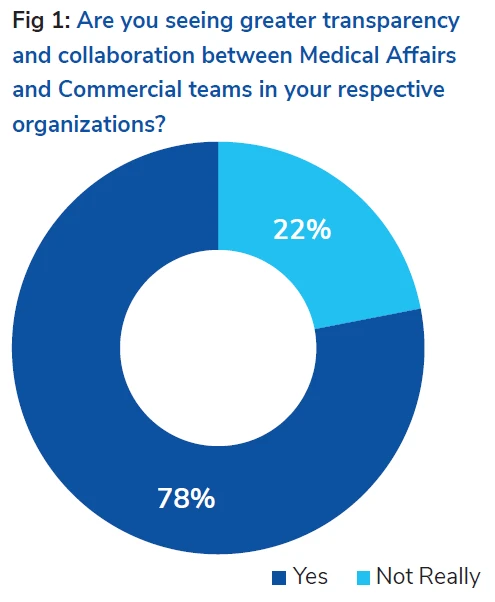
Traditionally, Medical Affairs and Commercial teams operated in parallel tracks, their interactions limited by compliance concerns, distinct “role-specific” objectives, and different success metrics. Yet today, 78% of Medical Affairs leaders report greater transparency and collaboration with their Commercial counterparts.
- A stronger push for patient-centric care that demands coordinated messaging and unified engagement.
- Evolving regulations such as those around Scientific Information on Unapproved Uses (SIUU) that clarify, rather than restrict, how scientific data can be shared.
- Digital transformation, which has made data sharing, insight generation, and omnichannel engagement both possible and necessary.
- Resource optimization pressures that make cross-functional collaboration not just beneficial but essential.
- Cultural evolution, where leadership champions open dialogue, shared objectives, and enterprise accountability.
Together, these factors are transforming the Medical Affairs function into a strategic co-lead that shapes scientific narratives, influences launch readiness, and bridges the gap between evidence and experience.
From Intent to Impact: What Collaboration Looks Like Today
For many organizations, collaboration is no longer an abstract concept but is a tangible reality. Council members highlighted the three most prominent outcomes (out of five) of closer alignment between the Medical Affairs and Commercial functions:
- Insight Sharing: Data and field intelligence are being validated, shared, and acted upon more systematically.
- Shared Infrastructure: Joint content libraries and engagement visibility platforms are creating operational cohesion.
- Common Customer Journeys: Both teams are documenting when and how they interact with healthcare professionals (HCPs) to avoid duplication and improve consistency.

However, leaders caution that this journey is far from linear. Misaligned goals between teams, inconsistent governance, and blurred roles continue to slow progress.
The Emotional Undercurrent: Cautious Optimism
While most Medical Affairs professionals report positive experiences, nearly half also admit to a degree of caution and hesitation, driven by the fear of being perceived as “commercially biased.”
This emotional undercurrent reflects a deeper cultural challenge: how to embrace collaboration without compromising scientific integrity. Leaders emphasize that the answer lies in clear boundaries, consistent communication, and visible executive sponsorship. Without these, even the best-intentioned partnerships risk reverting to silos.
Operationalizing Collaboration: From Models to Mindsets
Council members emphasized that true collaboration requires more than shared goals; it demands a deliberate shift in both operating models and mindsets. They highlighted the importance of early and consistent alignment on scientific strategy, the creation of shared systems that enable transparent exchange of insights, and the establishment of clear ownership across all points of the customer journey.
Equally critical is building mutual accountability through shared performance metrics, nurturing governance structures that empower co-leadership, and embedding collaboration skills such as business acumen and change management into the organizational DNA.
One early proof of concept, Project Unify (company name and specific results cannot be disclosed due to strict confidentiality requirements), demonstrated the power of this approach, showing measurable gains in cross-functional engagement, faster content review cycles, and improved HCP satisfaction as assessed via the Council survey feedback.
Now What: Turning Collaboration into a Competitive Advantage
The time for incremental change has passed. Collaboration between Medical Affairs and Commercial must now evolve from a compliance-managed partnership to a strategic growth driver, one that aligns scientific excellence with business impact.
Here’s what must happen next:
- Medical Affairs leaders should lead the charge in defining unified success metrics that clearly link their scientific contributions to enterprise outcomes. This includes shaping how objectives and tactics are written so that the metrics embedded within them demonstrate measurable impact on broader organizational goals. By strengthening their voice in early strategic planning and bringing evidence-based insights that influence brand and marketing decisions, they can ensure Medical Affairs is aligned with and advancing enterprise-level success.
Commercial teams must embrace Medical Affairs as equal co-creators—not validators—of strategy. Embedding Medical perspectives earlier in the lifecycle can ensure scientific integrity while enhancing customer experience. - Executive leadership must institutionalize collaboration by building shared infrastructure, revising key performance indicators (KPIs), and funding capability programs that reward partnership over siloed performance—for example, a program that helps Medical Affairs personnel better understand the commercial function and vice versa, to foster a more cohesive way of working. Leadership should also invest in capability programs that demonstrate appropriate collaboration while maintaining distinct accountabilities, ensuring both functions partner effectively without blurring their core responsibilities.
- Compliance and Legal functions should evolve into enablers, crafting clear but flexible guardrails that support innovation without compromising ethics.
- Industry associations and thought leaders, including organizations like DIA, can play a pivotal role by creating shared frameworks, publishing benchmarks, and convening dialogues that advance this integration across the industry.
This is not just about working together, it’s about redefining how science and strategy intersect to deliver greater value for patients, providers, and the industry at large.
Where there were once siloes, stronger collaboration is emerging. What happens next depends on whether we seize this moment to build an enterprise truly united by purpose, one where Medical Affairs and Commercial together define the future of pharmaceutical value and success.