



Medicines and Healthcare products Regulatory Agency (MHRA), UK
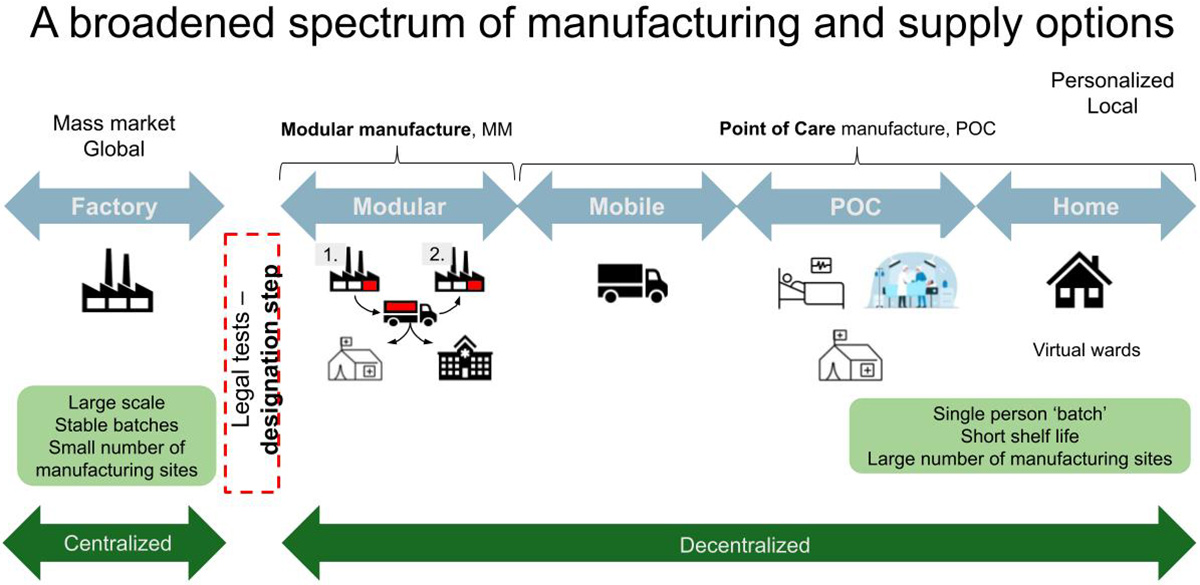
he UK has recently introduced legislation to support Decentralised Manufacture (DM), which is an extension to the traditional methods of manufacturing a medicine in a central factory site that allows medicines to be manufactured close to the patient, potentially over a wide range of sites and facilities, where this is appropriate and delivers patient benefit. The DM designation creates flexible options under either modular manufacturing (MM) or Point of Care (POC); the latter is particularly useful for administering medicines with very short shelf life to patients.
Need for Change
The trigger for change came through horizon scanning and reviews of enquiries received by the MHRA Innovation Office and Scientific Advice Meeting services which demonstrated that manufacture and supply of some products in conventional factory-based locations was not feasible and did not fit within the existing legal framework. Examples included advanced therapy medicinal products (ATMP) and blood and small molecule modalities, due to characteristics such as very short shelf lives and unique personalization. The EU Hospital exemption, limited to ATMPs, and manufacturing in the UK under a “Specials” (MS) license for unlicensed medicines still required manufacturing to be carried out in a controlled and defined setting in a fixed location, and so would not resolve this problem.
However, it was felt that the good manufacturing practice (GMP) manufacturing and supply requirements of these products could be met through a decentralized approach, which required significant changes to broaden the existing scope of UK medicines and clinical trial legislation. This new approach, while ensuring product safety, removed barriers to patient access for innovative therapies in clinical trials, marketing authorizations, or supply through named patient use.
In reviewing options for regulatory changes, new concepts such as a Control Site and a DM Master File (DMMF) were introduced to make the requirements for DM proportionate and sufficiently flexible to cope with expected scientific and technical developments.
These legislative amendments act as key enablers to implementing and operating a successful new regulatory approach but are still insufficient alone. Previous UK work on institutional readiness, started after the MHRA Innovation Office was formed in 2014, showed that to enable effective implementation of significant (disruptive) regulatory change, it was important that the institutions in which the GMP manufacturing is to be conducted, typically a hospital or other healthcare institution, first make the necessary procedural and cultural changes. The MHRA has worked with a wide range of UK organizations to develop their readiness, and with other regulators (first on a bilateral basis with US FDA, EMA, TGA [Australia], Health Canada, and Swissmedic, and later with a group of regulators through the International Coalition of Medicines Regulatory Authorities [ICMRA]) to ensure alignment of regulatory requirements.
Ensuring International Harmonization
Given the international nature of pharmaceuticals, these UK regulatory changes could not be made in geographic isolation. Innovators that manufacture and supply such products internationally need to know that regulatory requirements are broadly aligned across the world. A global perspective was needed to inform this new framework if it was to be compatible internationally.
For this, the MHRA worked with other international regulators, initially on a one-to-one basis and then from 2024 onward collectively through the ICMRA, which culminated in a workshop in December 2024. The DM workshop focused on three areas:
- Terminology and Definitions
- Good Practices (GxP) Technical Aspects across manufacturing, pharmacovigilance, and clinical topics
- Chemistry, Manufacturing, and Controls (CMC)
Several other regulators are implementing frameworks for DM, including provisions within the EU’s new pharmaceutical legislation and within US FDA’s Framework for Regulatory Advanced Manufacturing Evaluation (FRAME) Initiative.
Developing a New Regulatory Framework
To create the amending legislation, a public consultation was completed by January 2023, followed by drafting the legislative changes, creating an economic assessment of the impact of the changes, then formally presenting these changes in Parliament and the Northern Ireland Assembly. Following successful passage of the new legislation, SI 2025/87 was signed into UK law on 23 January 2025 and came into effect six months later, on 23 July 2025.
After the new legislation was signed into law, guidelines to help innovators interpret these requirements were developed through an in-person workshop in March 2025 and published on the MHRA DM Collection Hub. These provide an overview of POC and MM product types, as well as the requirements to consider for innovators seeking to advance these products.
The new regulatory framework is based on and links into the current regulatory systems for human medicine approvals, clinical trials, evaluation of regulatory compliance at manufacturing sites, and safety monitoring. The safety, quality, and efficacy of DM medicinal products remain paramount.
Decentralized Manufacture Concept and Framework
The DM framework applies to all categories of medicinal products including small molecules derived from chemical synthesis such as medicinal gases, biologicals and blood-derived medicines, and ATMPs. The framework applies to medicinal products manufactured under either the licensed route (i.e., Clinical Trial Authorisation [CTA] Applications and Marketing Authorisation Applications [MAAs]) or unlicensed route via “specials” legislation to allow manufacture and treatment for a named patient.
The innovator must submit justification of the suitability of DM to manufacture and supply specific products to the MHRA for approval. Not all products and processes will be suitable for DM: For example, the POC approach is primarily a “scale out” option contrasting with the current “scale up” model typically used for products that have long-term stability and are geared for large, uniform markets.
The new “hub and satellite” model introduced the Control Site as holder of the manufacturer’s license and supervisor and controller of the manufacture or assembly of DM medicinal products at all the remote, satellite sites. The DM Master File (DMMF) is a detailed description of the arrangements for the manufacture or assembly of a DM medicinal product collaboratively prepared by the sponsor or Marketing Authorisation Holder and the licensed pharmaceutical manufacturer. It captures product information (using eCTD format where appropriate) and information relating to the Control Site and its functions as well as the manufacture and control of the medicinal product at the satellite sites.
The MHRA will routinely inspect and authorize the Control Site and will inspect a representative group of the manufacturing sites based on risk to determine the state of their GMP compliance. The actual number of satellite sites that are inspected will be based on risk, taking into account the type of manufacturing processes, the detail within the DMMF with regards to the Control Site oversight, and the frequency of manufacturing activities. Where issues arise at the manufacturing sites, a proportionate increase in inspection activities may occur until the issues are resolved.

Step 1: Designation Application
To assure a risk-proportionate approach to the regulation of DM, justification of a decentralized rather than a centralized approach to manufacture, submitted via the appropriate application form, must first be accepted by the MHRA. This justification must demonstrate patient benefit and not be supported solely by economic or commercial reasons.
The MHRA process for evaluation of a justification for DM is termed the Designation Step, in which an application is evaluated against either the POC or MM legal tests. Any application for DM Designation is encouraged early in product and process development and may be submitted along with other early engagements with the MHRA such as Scientific Advice Meeting (SAM) requests.
Step 2: Extension of Manufacturing License Scope and the DMMF
The UK Manufacturing license application process has been extended to include the new approach for DM controls. Manufacturing sites should apply for the applicable product dosage form for MM or POC, supported by updates in their quality systems, to be added to their Manufacturer’s Authorisation for Investigational Medicinal Products (MIA [IMP]) license for clinical trial manufacturing. When submitting a new application or a variation to add DM activities, the site must also submit a completed DMMF for assessment.
Product Applicants and Manufacturing sites are required to ensure that a DMMF is in place for each DM medicinal product (MP). This document captures a range of manufacturing process and procedural aspects, including the location and status of manufacturing sites administered by a Control Site. This also includes processes relating to the onboarding, controlling, and closing of a satellite site of manufacture, for example.
An example of the proportionality in the regulatory changes relates to changes in manufacturing sites; since these details are in the DMMF, the need to vary product and manufacturing licenses when these sites change has been removed.
Step 3: Application for a DM Product Authorization
The designation step and updates to Manufacturing licenses ensure that the rationale and quality for DM products can be confirmed and assured before treating patients. For example, CTA applications for clinical trials must include a valid designation status of the MP manufacturing and name a manufacturing site authorized for DM Control Site activities to avoid default rejection on this account. Applications will also need to include the relevant DMMF.
Applications of DM: Point of Care and Modular Manufacture
Modular Manufacturing (MM) allows for decentralized, relocatable manufacture that could be accomplished in a factory but, for reasons of deployment, must be executed geographically closer to the site of product administration. MM is also known as POD (Portable on Demand) manufacturing.
Point of Care (POC) allows for safe manufacturing of medicines at or near the place where the product is to be used or administered, such as at a patient’s bedside. These products typically have short shelf life (often less than one hour) as starting material or finished product.
This also facilitates conducting clinical trials at appropriate locations where both the quality of the medicine and the safety monitoring of the patient can be assured.
Conclusions
Decentralised Manufacturing opens a world of opportunity for all developers of medicines that need this approach to manufacturing, to ensure patient access via a risk-proportionate and controlled method of regulation.
The MHRA is open to applications for the approach for all dosage forms and product types. Use of DM will be monitored to determine when the issued guidance needs to be updated to continue to support innovators using this approach. We will also continue to work in partnership with other global regulatory bodies toward this goal.