



Kapil Naudiyal
Tata Consultancy Services Limited
ood clinical trials depend on good data, and Clinical Data Management (CDM) has long played the quiet but critical role of keeping that data reliable, usable, and ready for review. But while Electronic Data Capture (EDC) systems have largely replaced paper forms and improved primary data entry, much of the broader process is still sequential and reactive. It still depends heavily on structured data, manual checks, and downstream issue resolution.
Clinical Data Management at Inflection Point
The challenge is compounded by the explosion of data from diverse sources like EHRs, wearables, and genomics, which creates immense integration complexities. Furthermore, the rise of adaptive and decentralized trials leads to frequent midstudy changes, making traditional, reactive quality-control methods inefficient and resource intensive. The resulting data silos and lack of real-time analytics hinder the ability to gain swift, actionable insights, highlighting the need for CDM to evolve.
Together, these challenges are pushing CDM beyond traditional data cleaning toward a more insight-led CDS (Clinical Data Science) model.
Moving Beyond Data Management
Clinical organizations now need to go beyond what traditional CDM was designed to deliver, which was primarily to ensure that data is “managed the right way.” CDS expands this focus to include data risk, data meaning, and data value, ensuring that data is not only clean but also credible, reliable, and actionable for prompt decision-making. This broadens the focus from just “Are the data clean?” to “Are the data reliable and useful for decisions now?”, a shift that turns clinical data from an operational deliverable into a living asset that guides trial execution.
Industry Reality Check
The shift from CDM to CDS will be incremental, not sudden. Many clinical teams still work with fragmented systems, multiple vendors, uneven metadata practices, and workflows that were not designed for AI-enabled operations. As interest in AI grows, the real adoption question is practical: Can these outputs be trusted, validated, explained, and safely used in regulated clinical decisions?
Emergence of Agentic AI
Generative AI has already shown how quickly knowledge work can change: summarizing documents, drafting content, finding patterns, and helping teams reason across large bodies of information. The next phase is likely to be more operational. It will involve agentic AI: systems that can take a defined goal, interpret context, plan steps, and work with humans or other agents to complete a task.
In clinical data management, an agent does not need to be mysterious or fully autonomous. It can be a focused digital worker assigned to a well-bounded activity: checking incoming data for anomalies, proposing electronic case report form (eCRF) specifications from a protocol, comparing vendor data with EDC records, suggesting medical coding terms, or escalating site-level risk signals for review.
Agents will be most useful when they sit inside the workflows teams already depend on, with the right controls around them. They should recommend, document their reasoning, and keep expert review where judgment matters. Used this way, agentic AI can help teams move from periodic checks to more continuous, informed oversight. The bigger opportunity is not simply to automate tasks, but to help teams spot issues earlier, explain what they are seeing, and respond with more confidence.
Intelligent Interventions Across the Clinical Data Lifecycle
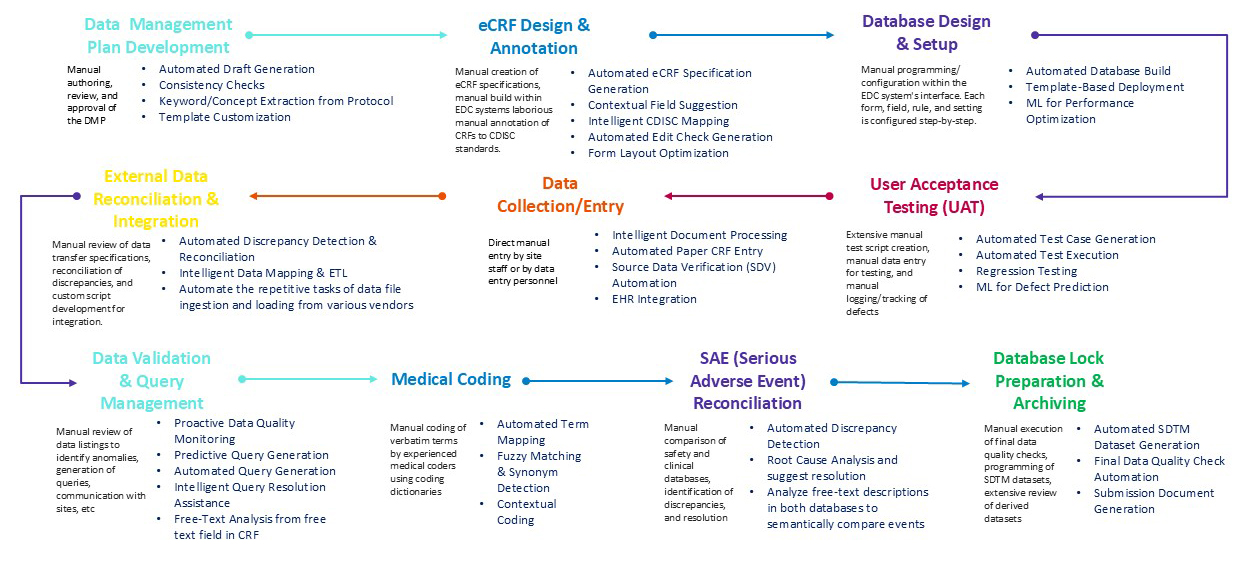
The opportunities for intelligent intervention span much of the CDM process. Protocol interpretation, eCRF design, edit-check creation, data review, reconciliation, coding, quality management, and database lock all contain repeatable work where AI can assist.
Reimagining Core CDM Functions
In study start up, AI agents can help translate protocol requirements into draft eCRFs, validation logic, metadata, and mapping suggestions. These outputs still need expert review, but they can give teams a stronger starting point and improve consistency across studies.
During study execution, agents can monitor incoming data, identify missing or unusual values, and suggest contextual queries. Instead of relying only on scheduled review cycles, teams can address issues closer to the point at which they occur.
Consider query management, one of the most resource-intensive activities within many clinical studies. Agentic AI can improve this workflow by leveraging protocol requirements, historical patterns, and clinical context to identify issues earlier, prioritize critical discrepancies, and draft contextualized queries. The value lies not just in faster query generation, but in shrinking the cycle time between detecting an issue and resolving it.
Reconciliation is another high-value area. Agents can compare data across EDC, labs, safety systems, devices, and other sources; identify discrepancies; propose likely matches; and route exceptions for human review. Medical coding and serious adverse event reconciliation can benefit in a similar way, especially where narrative text, terminology, and cross-system comparison add complexity.
The near-term value of agentic AI is not in fully autonomous trials, but in reducing repetitive work so clinical data professionals can focus on exceptions, study risk, cross-functional decisions, and patient-relevant outcomes. Used within governed workflows, agents can help teams scale expertise across process-heavy, data-rich, time-sensitive activities without compromising quality.
Building the Intelligent Clinical Trial
A few isolated AI pilots will not be enough to define the future of CDS. It will require networks of specialized agents connected to the systems, metadata, standards, and governance that already shape clinical development.
For example, a protocol intelligence agent may inform eCRF design. A data-quality agent may share signals with a risk-monitoring agent. A reconciliation agent may provide evidence to a medical reviewer or coding specialist. In each case, the value comes from joining operational steps that are often treated separately today.
Human expertise remains central. Clinical data managers, programmers, statisticians, and medical reviewers provide the judgment and accountability that AI cannot own. Their roles will increasingly shift from manual task execution to strategic oversight of AI-driven insights. Agentic AI should expand their reach, not blur responsibility. The best operating model is therefore human-led and AI-augmented.
Roadmap Toward Clinical Data Science
Moving from CDM to CDS will require more than deploying new tools. Organizations will need modern data foundations, metadata discipline, clear ownership, validation approaches, responsible AI controls, and workforce development.
Trust will become a design requirement, not an afterthought. In regulated clinical development, AI must be useful, auditable, and governed according to how much the decision matters for patient safety, data quality, and trial outcomes. Practically, this demands robust validation frameworks, immutable audit trails for every agentic action, and continuous performance dashboards. If organizations approach this well, the benefit will go beyond efficiency. They can catch problems earlier, reduce end-of-study surprises, strengthen oversight, and make better decisions while the study is still in motion.
Conclusion
Clinical Data Management has always evolved to meet new challenges, and the shift toward Clinical Data Science is the next logical step. Agentic AI offers a path forward, not by replacing human experts, but by augmenting their ability to identify issues earlier, connect siloed information, and scale their expertise. The organizations that succeed will be the ones that keep people accountable, make AI trustworthy in day-to-day use, and apply it where it genuinely helps teams make better study decisions.